 lefteros
LEFTEROS / PERSONAL NOTES
Omarchy on the Pixel 8 Pro: Wi-Fi, 120 Hz and better charging
2 November 2026 / Lefteris Iliadis / SomniusX
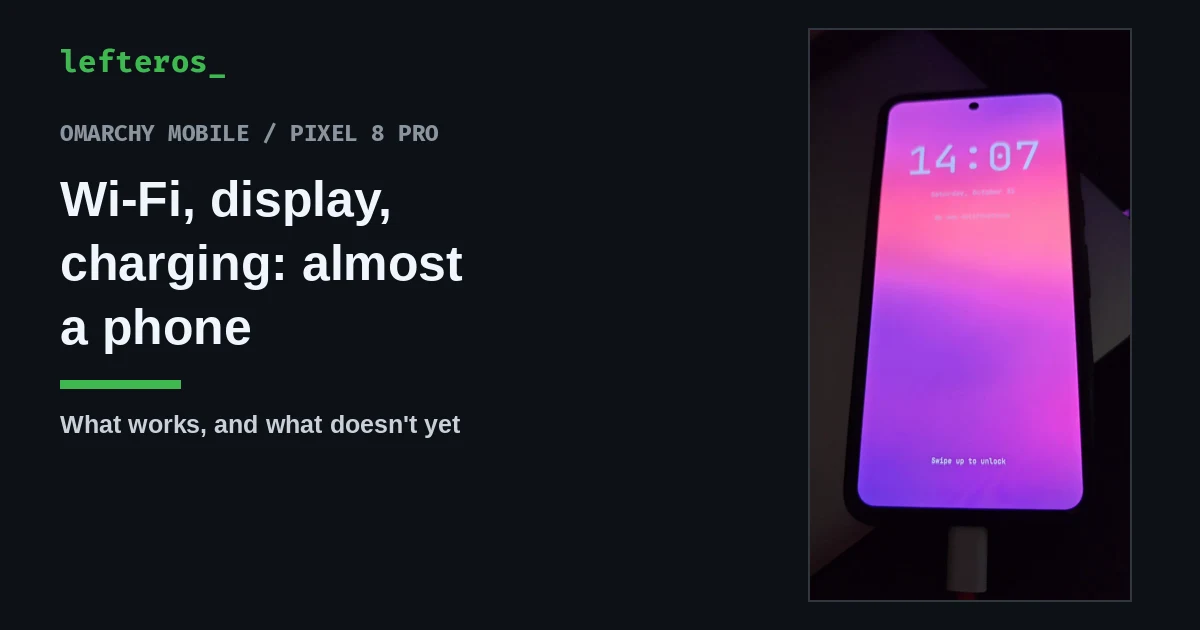
My Pixel 8 Pro runs Omarchy Mobile from slot B, with GrapheneOS still on slot A as the way back. In the last post the battery had just started reading and charging was a trickle. A lot moved after that, so here's where it stands.
It's still not a phone you can use every day. There's no modem yet, and most of this runs on a test kernel with some things loaded by hand. Everything below was measured on my phone.
Wi-Fi
This is Brett's Wi-Fi work on his test kernel, running on my phone. It connected at 5 GHz, and I left it on a 40-minute run: 41 timed downloads, 221 to 502 Mbit/s, 367 on average, no drops. The remote host and my router set that ceiling, not the phone. Brett's earlier baseline was 2.4 GHz.
The firmware comes from my own phone's vendor image. It isn't shipped with anything.
There's one open issue: the kernel log fills with No PKTID available errors, up to about 193,000 lines in one boot. It doesn't seem to hurt the connection, but I don't know the cause yet, and the numbers are with Brett.
GPU and display
The Mali-G715 runs, the screen does 1344x2992 at 120 Hz with brightness, and Hyprland draws on the GPU. Touch and the keys work too.
Charging
My wall charger test from last time gave about +40 mA, and I found out why it looked so bad: that was a OnePlus charger on a USB-A port. With a Baseus 30 W charger and a USB-C to USB-C cable the fuel gauge reported about +1.49 A, in a run of about 3.5 minutes with the screen off. That's the gauge's own reading, right at the 1.485 A limit Derek set, and it isn't confirmed with an external meter yet. I don't claim fast charging.
I don't know why 1.5 A got through at that point, because the input limit register still read 500 mA. That's an open question.
Battery temperature is now correct too, once Google's battery model is loaded.
Type-C
The Type-C driver now loads on the phone as a power sink. It sees a 3 A source, keeps USB and Wi-Fi up, and the charger's input limit follows it, from 500 mA to 3 A, with no resets. Unplug and replug work: USB comes back by itself. Without this driver, the rescue service from #250 does that job, and it's merged now.
It's still loaded by hand, and no USB Power Delivery contract has been tested.
Host mode, not yet
The USB controller does switch to host mode and back, and two root hubs appear. But the phone doesn't supply 5 V on USB-C yet, so nothing plugged in can work. So no keyboards, flash drives or dongles. The next step waits on Derek's review, in a draft PR, and on a USB-C meter I still need to buy.
The boot
The boot had an ugly gap: after the splash, about 27 seconds of black screen before the lock screen. Reading the logs, it was a 25-second portal timeout, on every boot. With a small override on my phone, the lock screen came up about 24 seconds sooner, with no timeout. That reading of the cause isn't confirmed in the portal code, and I don't know yet if other phones get it, so it's in issue #277, not in a package. The override also trades the GNOME file chooser for the GTK one.
The splash now shows the Omarchy logo: #278 and #285, both open.
Small things
- The lock screen shows battery level and a charging bolt (#267, open). I checked it on the PIN screen, while charging.
- Folders in Files open with one tap (#271, in main).
- I'm trying a one-tap English/Greek key on the touch keyboard, and switching between English and Greek worked. It's a local trial. It crashed once and I couldn't reproduce it, so the cause is unknown.
- Gauge overlays can now be generated from Google's public source (#279, open).
What I haven't tested
- 5 V out on USB-C, and any USB device attached to the phone.
- USB Power Delivery, and anything above the default charging limits.
- Charging above the default limits with the Type-C driver loaded, checked with an external meter.
- The splash on its own, without my local changes.
- The lock screen battery in its glance view, or during an unplug.
- Bluetooth, audio, cameras and the modem.
- Whether the slot B boot marker I set on my phone holds up after a flash. That's local only and it's Derek's call upstream.
It also gets hot: one sensor went past 80 °C under load, within seconds. That needs watching.
Thanks
Derek Ross maintains the project and reviewed everything. Brett-Michael Green did the kernel base, touch and display. Thanks also to W4HO-ham, nesmeck and Alejandro García León for the work on their phones that helped mine. My part is on GitHub as Somnius, and the status lives on the app page.