 lefteros
LEFTEROS / PERSONAL NOTES
Call to arms for Omarchy Mobile: making it a real alternative to Android
17 November 2026 / Lefteris Iliadis / SomniusX
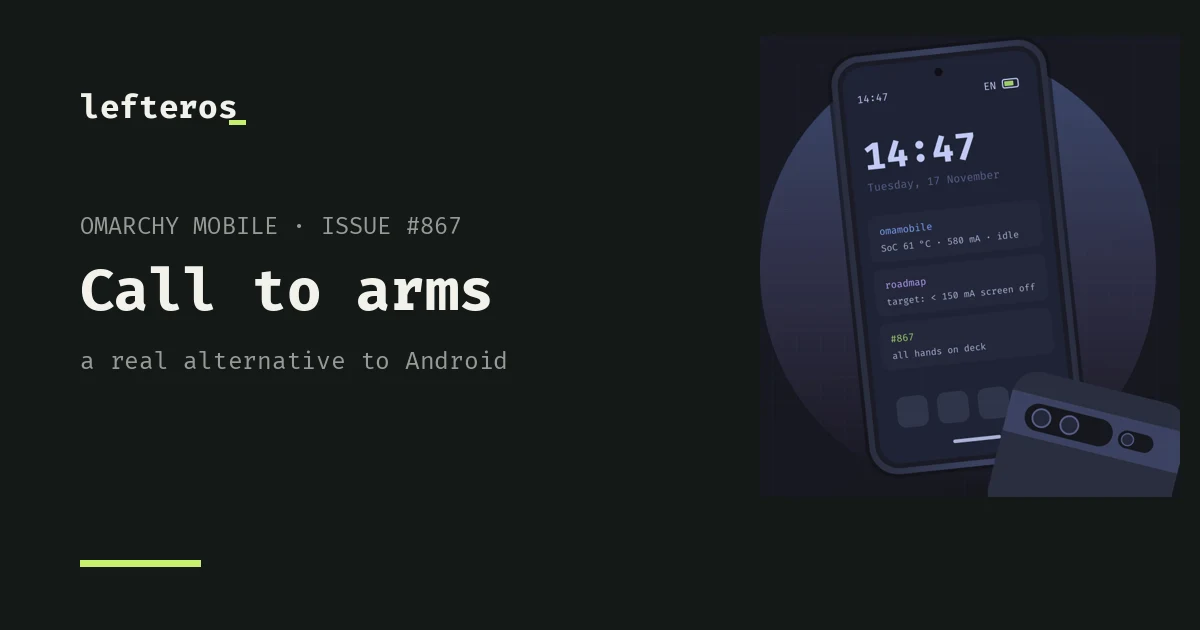
Today I opened a big issue on Omarchy Mobile, the project that puts Omarchy Linux on phones: #867, a call to arms.
In short: booting Omarchy on a phone is an achievement, but it isn't enough. For Omarchy Mobile to become a real alternative to Android, the way Omarchy is today an alternative to macOS on Apple Silicon, our phones have to run cool, last the day and be ready whenever you pick them up. Right now they don't, and none of us can fix that alone on one device.
Why it matters
Android phones don't get there by luck. Each vendor ships code tuned to its own CPU and GPU: short bursts of speed for a job and then straight back down to minimum power, apps that aren't needed kept at bay, priority for what matters right now like the screen, and waking every so often to pick up notifications and show them in one go. The rest of the time the phone runs on the bare minimum, so the battery lasts.
We don't have that as a whole yet. There is good work in pieces (power profiles, a battery saver on the Pixel 9a, the sleep runbooks, the thermal work on the 9a), but no shared plan for how the software meets the hardware.
Where my Pixel 8 Pro is today
- Screen off, nothing running: a 10-minute log on battery gave a steady median of 515 mA, and later runs sat at 520-540 mA. The battery gauge isn't calibrated, so the numbers are rough. One reading on a warm phone showed 61 °C on the SoC.
- Screen on, a text editor (omawrite) and a Bluetooth keyboard, mostly idle: 71-73 °C. That's where my own thermal guard starts capping the CPU.
- It isn't the apps: pausing the shell and my background tools together cut about two thirds of the context switches, and the current didn't move. Wi-Fi power save was the one userspace change that helped, about 30 mA.
- It's the kernel: no CPU idle states (cpuidle), no memory bus scaling (devfreq), and nothing that turns off unused clocks and power domains. So with the screen off, that 515-540 mA floor comes from the kernel.
- Screen on, the shell and the compositor were around 45 % and 40 % CPU. Why, I don't know yet; constant redraws, blur and 120 Hz are the candidates, none measured.
Another Pixel 8 Pro, gitColinX's, shows the same picture. The Pixel 9a has its own walls: under full load it went from about 55 °C to the 105 °C critical trip point in roughly 8 seconds and the kernel shut the phone off, and without idle states any sleep past three minutes ends with the system watchdog killing services (the 9a has a stopgap merged; the real fix is idle states). I got the same on the 8 Pro after a 270-second sleep.
For comparison, Google's own power model puts a stock Pixel 8 Pro at about 77 mA with the screen off and the phone awake. That's a model, not a measurement, but it shows how far we are.
Running warm all the time isn't just uncomfortable in the hand. Over months it's a risk, for the battery first of all. I haven't measured any wear; I just don't want to find out the hard way.
What I proposed
- A ten-minute recipe, a few commands over ssh that change nothing on the phone, so every device team measures its own phone the same way and posts one comparable baseline.
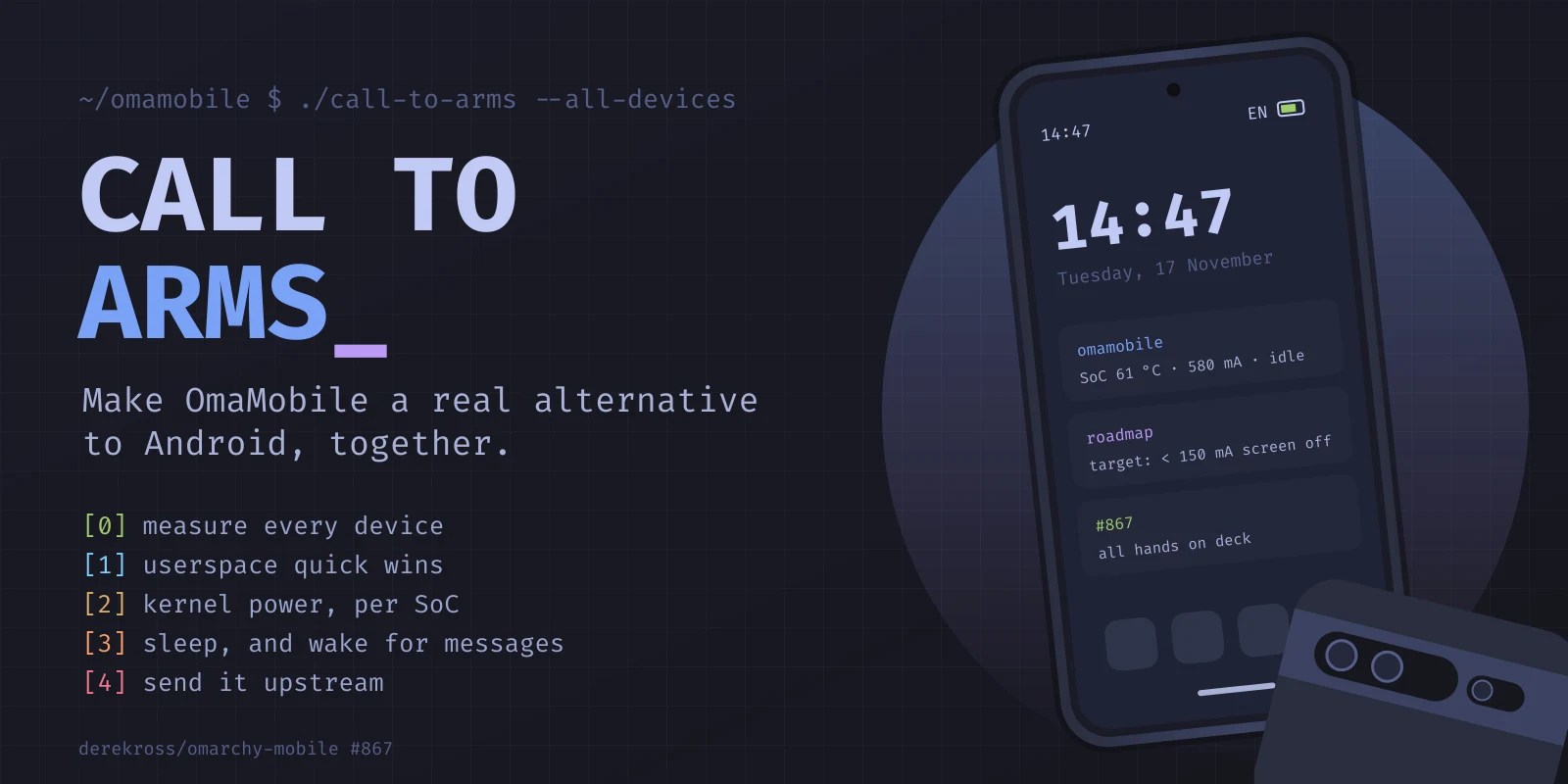
- A roadmap in five phases, numbered 0 to 4 as in the issue, each with a "done when" target that's a proposal to argue about:
- Measure every device and share the results.
- Quick wins in userspace: 60 Hz by default on phones with 120 Hz as a choice in Settings, animations, blur and shadows measured before picking phone defaults, a shell that doesn't redraw when nothing changes, power profiles, Wi-Fi power save.
- Power management in the kernel, per SoC: idle states (cpuidle), memory bus scaling (devfreq), power domains, proper thermal zones. Among its targets: under 150 mA with the screen off, on battery, after 10 minutes.
- Sleep, and waking for notifications: the phone sleeps in your pocket and still gets its messages. Among its targets: under 10 % battery for 8 hours with the screen off, on battery with Wi-Fi connected.
- Send each fix where it belongs: Omarchy upstream, the mainline kernel, or staying in Omarchy Mobile. A laptop on battery gains from many of the same fixes.
- Organizing as a team: an owner per layer (kernel, thermal, sleep, shell, background apps, upstream), not per device, plus a direct channel and regular calls, because issue threads are good for results and bad for deciding things. I offered my shared-hosting server if it helps.
I called on everyone testing a device to run the recipe: the Pixel 6a, 7 Pro, 8a, 8 Pro, 9a, 9 Pro Fold, the Pixel 10 family, the 11 Pro XL, the OnePlus 6, the Redmi Note 7 and the Galaxy A22 5G.
The pledge
I pledged my Pixel 8 Pro to Omarchy Mobile, whole, and afterwards my OnePlus 13. I'm not joking.
So nobody starts from zero, the issue also lists my work on the 8 Pro, 27 of my 73 issues and pull requests: power and charging, sleep, USB, keyboard and haptics, the Settings pages, the modem plan and more.
If you care about Linux on phones, take a look at #867, and if you have a device, run the recipe. 🐧📱
More about my work on the 8 Pro is on the Omarchy Mobile page.