 lefteros
LEFTEROS / PERSONAL NOTES
When the systems that manage your infrastructure become the attack surface
18 November 2026 / Lefteris Iliadis / SomniusX
The Check Point and Puppet vulnerabilities show why infrastructure management platforms deserve the same security attention as the systems they protect.
In the space of five days, CISA added two very different bugs to its catalogue of known exploited vulnerabilities. On 13 November, a privilege escalation in Check Point's Gaia OS, the operating system of its firewalls and management servers. On 17 November, a deserialization flaw in Puppet, the configuration management system that tells thousands of servers what to install and how to be configured.
One is a local bug in Gaia, on firewalls and management servers, the other a network bug in a DevOps tool. They don't share code or mechanism, and nothing public links the attackers. What they share is where they sit: both live in the layer that administers everything else. That layer, the management plane, is where an attacker gets the most leverage for the least effort, and it's often the part we secure last.
Two vulnerabilities at a glance
| Check Point | Puppet | |
|---|---|---|
| CVE | CVE-2026-123039 | CVE-2026-115731 |
| Type | Local privilege escalation to root (CWE-732, CWE-862) | Deserialization of untrusted data, code execution (CWE-502, CWE-94) |
| Score | CVSS 7.8 (Check Point; version not confirmed) | CVSS 4.0: 9.4 (Perforce); CVSS 3.1: 9.9 (Red Hat) |
| Needs | Code already running on the gateway | Any CA-signed agent certificate |
| Remote? | No, local. Chained after PHP2Shell | Yes, over the network (port 8140) |
| In CISA KEV | 13 Nov 2026, due 16 Nov | 17 Nov 2026, due 1 Dec |
| Fixed in | R82.20 JHF Take 14, R82.10 Take 52, R82 Take 132, R81.20 Take 174 | Puppet Enterprise 2023.8.13, 2025.12.1, 2026.0.1; OpenVox Server 9.2.0 / 8.18.0 |
| Exploitation | Confirmed by Check Point: about two dozen customers | Listed as exploited by CISA; no public details on who or how |
Check Point: from gateway compromise to root
The Check Point story starts with a bug that isn't Check Point's. PHP2Shell (CVE-2026-109618 and CVE-2026-109619) is a pair of remote code execution flaws in PHP itself, fixed on 21 October and added to KEV on 26 October. Check Point's Mobile Access portal runs on PHP, and Check Point shipped its own fix for gateways on 23 October.
According to Check Point Research, attackers used PHP2Shell on the portal to run code as the portal's service account. That's a foothold, not control. The second step was CVE-2026-123039.
The mechanism, as described in sk1000362 and the KEV entry, is almost old-fashioned. Gaia's Dynamic CLI uses a daemon, dynamic_server, that runs as root and listens on a local socket, /tmp/dynamic_socket. That socket was created world-writable (0777) and the daemon didn't check who was connecting. Any local process could send it a command and have it executed as root. No memory corruption: a permission mistake on a privileged IPC channel.
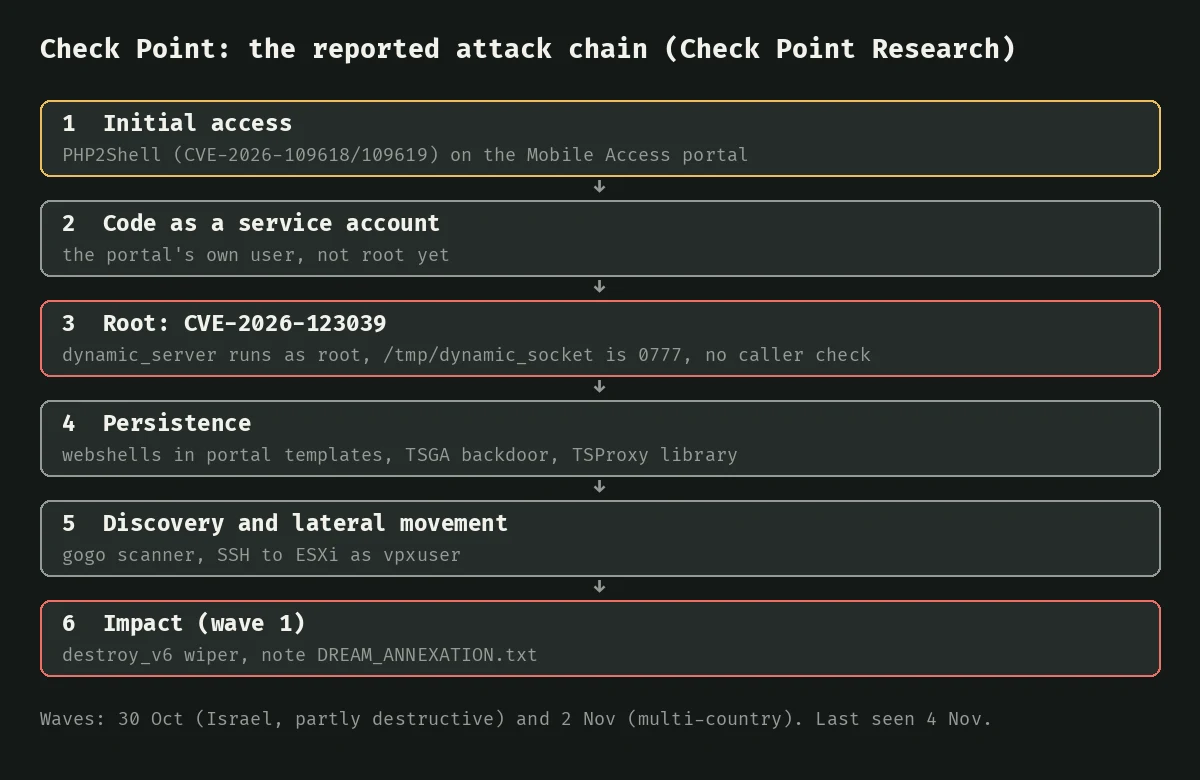
With root, the attackers settled in. Check Point Research lists webshells hidden in the portal's templates, a backdoor it calls TSGA (living as /tmp/CPconfigdaemon) that steals configuration and tampers with firewall logs, and a proxy library, TSProxy, placed as /lib/libcpfwcommon.so. From the gateway they scanned the internal network with the gogo scanner and logged into VMware ESXi hosts over SSH as vpxuser, the account vCenter uses to manage hosts. In the first wave, on 30 October against Israeli organizations, in some cases they ran a wiper, destroy_v6, and left a Hebrew note, DREAM_ANNEXATION.txt, signed "Dream Security Ltd". A second wave on 2 November reached several countries without destruction seen. The last activity Check Point saw was on 4 November; the advisory came on 12 November.
On attribution, Check Point Research is careful, and so should we be. TSGA and TSProxy are variants of PhiliKit, which ESET has linked to the China-nexus group UNC5221, but a destructive, Israel-focused operation with a Hebrew note doesn't fit that group. Check Point Research puts its confidence at low and lists a false flag among the possibilities. No actor is named.
What to do: install the November Jumbo Hotfix take for your release. Per sk1000362, R81.10 and R81 are affected and have no fix listed (end of support): upgrade, or use the documented workaround of stopping dynamic_server, which breaks the Dynamic CLI commands listed in sk144112. After patching, ls -l /tmp/dynamic_socket should show srw-rw---- owned by root, group config. For forensics, Check Point points to /var/log/dynamicCli.log: legitimate requests come through the Clish wrapper, and fixed builds log "Rejected connection from unauthorized uid". Note that Check Point's own blog table lists only R81.20 to R82.20 as affected; the sk also lists R81.10 and R81. I'd go by the sk.
Puppet: when configuration management becomes the attack vector
Puppet works on trust. Every managed machine runs an agent with a certificate signed by the Puppet Server's own certificate authority. After each run, the agent sends the server a report: what changed, what failed, every event.
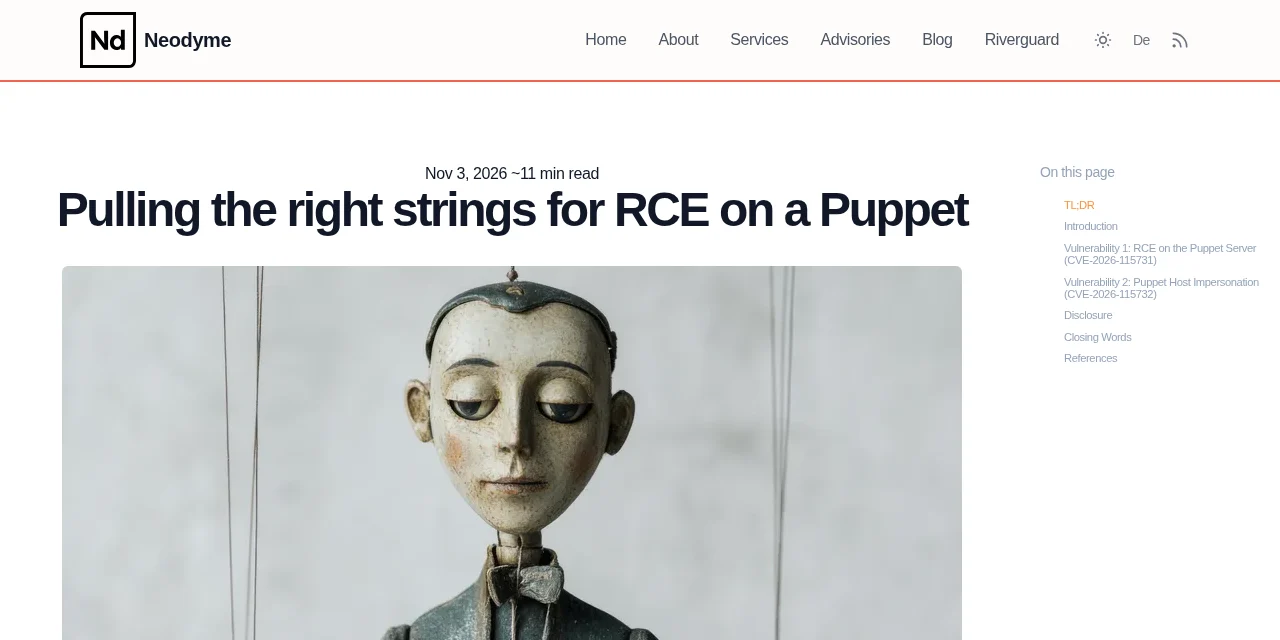
CVE-2026-115731 is in how the server reads those reports. As Neodyme, whose researcher reported it and describes using it in a red team engagement, explains: report events can carry Puppet's "rich data", serialized objects with type information. When the server rebuilds them, attacker-controlled type information reaches a code generator that ends in Ruby's class_eval. The result is code execution on the Puppet Server as its service user, through a PUT to /puppet/v3/report/ on port 8140. Neodyme traces the bug back to open-source Puppet 6.24.0, from July 2021.
The prerequisite matters, and it's where the "authenticated" label can mislead. The attacker needs a CA-signed agent certificate. That sounds like a real barrier, until you remember how many Puppet installations use autosigning: the CA signs any certificate request that arrives, or any whose name matches a pattern, so new machines can join without a human. The CVE record says it plainly: where the CA autosigns without strong verification, an unauthenticated network attacker can obtain a valid certificate and exploit the bug. With basic autosign, "needs a certificate" means "needs network access to port 8140".
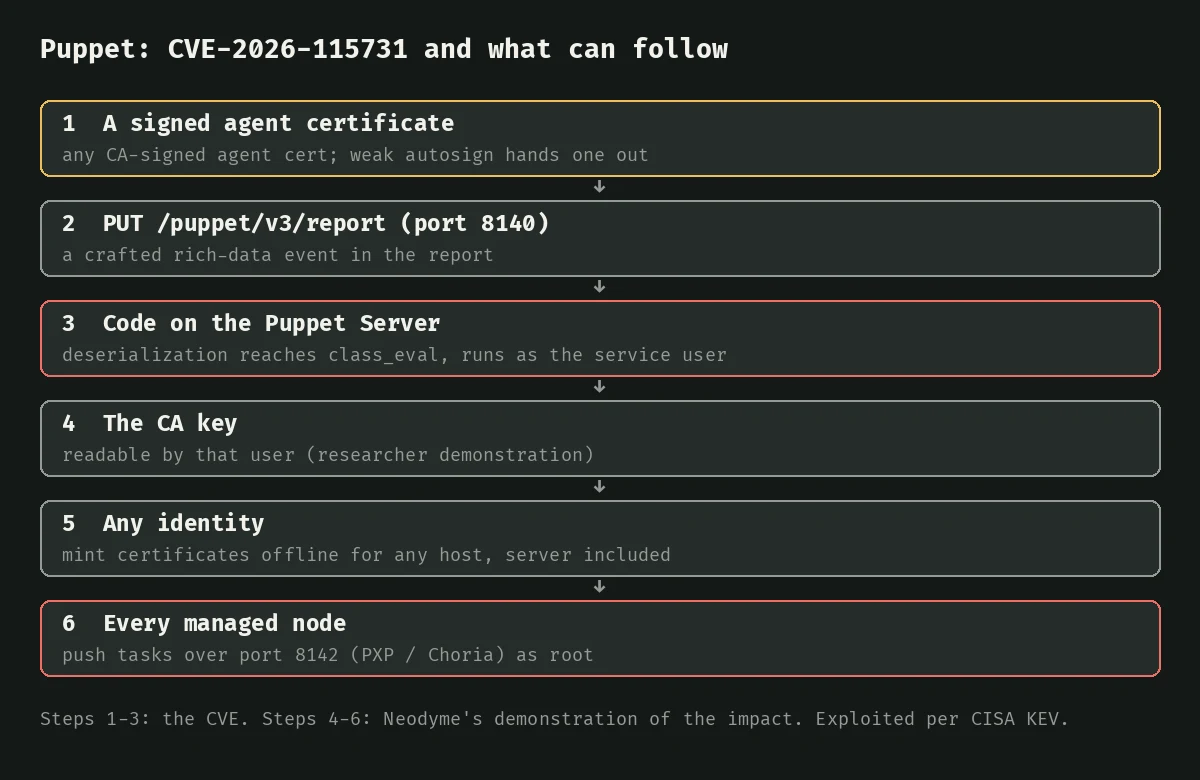
The impact is where Puppet stops being "one more server". The service user can read the CA's signing key. Neodyme showed that with it, an attacker can mint certificates offline for any name, including the Puppet Server's own, and use one on the orchestration broker on port 8142 (PXP in Puppet Enterprise, Choria in OpenVox) to push a task that runs as root on managed nodes. Red Hat summarizes it as compromising "the central certificate authority and all downstream managed systems". A compromised Puppet Server isn't one host lost; it's your provisioning pipeline turned around.
CISA lists the bug as exploited, but nobody has published who, how or against whom. I found no named campaign or victim. Be careful with reports that mix it up with CVE-2026-115732, a separate certificate-name check flaw disclosed alongside it, whose only exploitation claim comes from a forum thread.
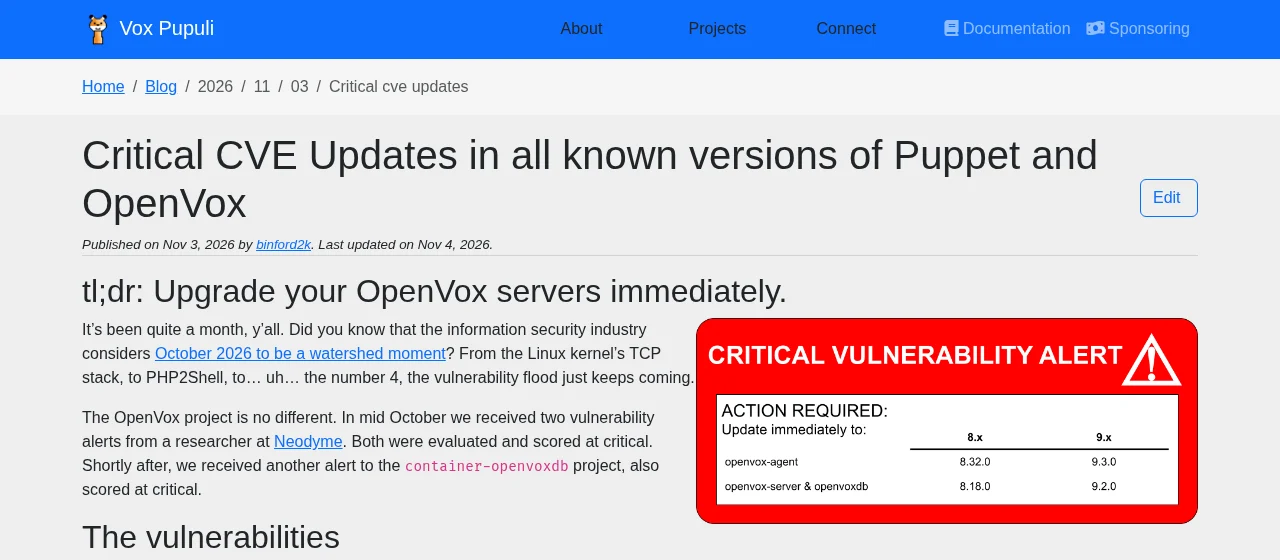
What to do: upgrade Puppet Enterprise to 2023.8.13, 2025.12.1 or 2026.0.1 and restart Puppet Server. On OpenVox, go to server 9.2.0 or 8.18.0 and agent 9.3.0 or 8.32.0. Vox Pupuli says all known Puppet implementations are affected and open-source Puppet gets no more updates. If you can't patch today, turn off basic autosign or replace it with a policy executable that really verifies requests, and allow ports 8140 and 8142 only from the networks that need them. If you suspect a compromise, assume the CA key is gone too. That means a CA rebuild and new certificates for every node, which is worth planning before you need it.
The management plane: the infrastructure's crown jewels
Put the two cases side by side and the pattern is about position, not code. A firewall is trusted to see and steer all traffic, and in this campaign it was the jump host to the hypervisors. A Puppet Server is trusted to tell every node what to run, as root. Neither attack needed to break the systems downstream. They inherited the trust those systems already gave their manager.
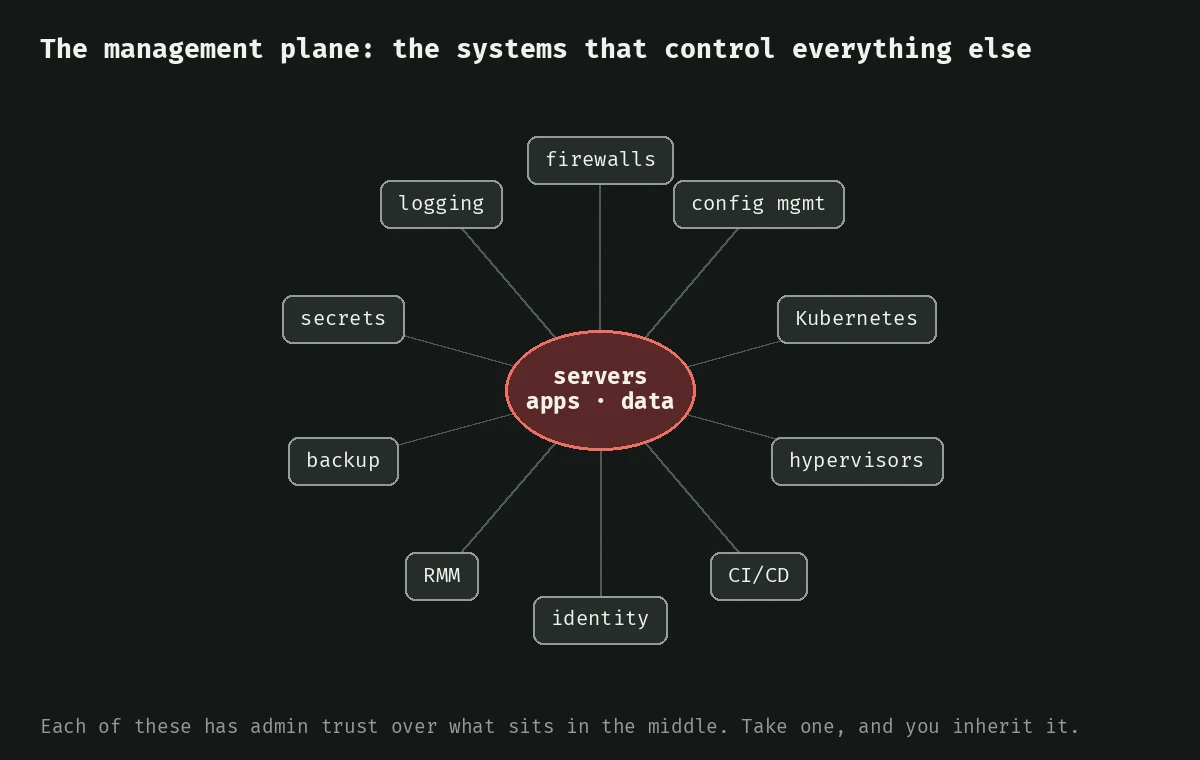
The same holds across the list:
- Hypervisors and vCenter: one login, every VM, including their disks and snapshots.
- Kubernetes control planes: cluster-admin is root on every workload.
- CI/CD: build systems hold deploy keys and sign what goes to production.
- Identity providers: whoever controls sign-in controls every app behind it.
- RMM tools: remote shells on every endpoint, by design.
- Backups: the last line of recovery, and often the first thing a destructive attacker deletes.
- Secrets managers: the keys to everything else, in one place.
- Logging and monitoring: where you'd see an attack, and where TSGA went to tamper with firewall logs.
These systems usually run with the highest privileges, talk to everything, and are managed by small teams with less change control than production. They're also often patched last, because touching them feels risky. That combination is what attackers look for.
What organizations should be doing differently
For sysadmins and infrastructure engineers
- Patch the management plane first. Order fixes by blast radius, not only by CVSS. A 7.8 local bug on a firewall that reaches your ESXi hosts outranks a 9.8 on an isolated test box. KEV entries with "forensic triage required", like the Check Point one, mean patch and then look for traces.
- Keep management interfaces off the internet. The Check Point chain started on a remote-access portal that has to face the internet; admin interfaces don't. Admin portals, Puppet's 8140/8142, vCenter, Kubernetes APIs and RMM consoles belong on a management network reachable through VPN or a bastion, with allow-lists.
- Segment by trust, not by team. A gateway shouldn't be able to SSH to hypervisors. Puppet agents need to reach the Puppet Server, not the rest of the management network. Write down which management system may talk to which, and enforce it.
- Treat certificate issuance as an authentication decision. Basic autosign is "anyone may join". Use policy-based signing with a pre-shared secret or a cloud instance identity check, review the list of signed certificates, and know how you'd revoke and rebuild the CA.
- Separate and watch privileged accounts. Service accounts like
vpxuserexist for one manager talking to one class of host. Alert when they're used from anywhere else. - Log where the attacker can't edit. Ship firewall, Puppet Server and hypervisor logs off the box in real time. TSGA tampered with local binary logs; a remote copy taken before that is what survives.
- Keep backups out of reach. Offline or immutable copies, credentials that the hypervisor admin account doesn't have, and a restore you've actually tested.
- Have a compromise playbook for each management system. For a firewall: reimage, rotate every key and VPN secret it held. For Puppet: rebuild the CA, reissue certificates and check catalogs for changes. Write it before you need it.
For security architects and CISOs
- Run a risk assessment of the management plane itself. List every system that can change, configure, authenticate, back up or watch other systems, and score what an attacker inherits from each.
- Keep an inventory of privileged infrastructure, with an owner, a patch level and an exposure for each item. Most organizations can list their servers faster than their admin tools.
- Include vendors and their dependencies. PHP2Shell reached Check Point through PHP. Ask suppliers which third-party components their appliances run and how fast they ship fixes.
- Give KEV a fast lane in your vulnerability policy. Three days was CISA's deadline for the Check Point bug. If your process can't patch a firewall in three days, decide in advance who can approve the emergency change.
- Test detection on the management plane. Can you see a new process under
puppetserver, a root shell on a gateway, an SSH login to ESXi from a firewall? If not, that's the gap. - Make someone accountable. Name an owner for each management system who decides on patching and exposure, and reports to someone who can fund it.
The NIS2 perspective
For organizations in scope of the EU's NIS2 Directive, none of this is new territory, and it's worth being precise about what the law actually requires.
Being affected by a vulnerability doesn't by itself breach NIS2. What NIS2 requires is "appropriate and proportionate" risk-management measures under Article 21. Its list maps closely onto these two cases:
- incident handling (21(2)(b));
- business continuity, backup management, disaster recovery and crisis management (21(2)(c));
- supply chain security (21(2)(d));
- security in acquisition, development and maintenance, including vulnerability handling and disclosure (21(2)(e));
- human resources security, access control policies and asset management (21(2)(i));
- multi-factor or continuous authentication and secured communications, where appropriate (21(2)(j)).
Article 21(4) adds that shortcomings are to be corrected "without undue delay". A firewall left unpatched months after a KEV listing is hard to call appropriate.
Article 20 makes management bodies approve these measures, oversee them and follow training, and says they can be held liable for infringements. "The firewall team didn't patch" doesn't end the conversation.
If an incident is significant, Article 23 sets the clock: an early warning within 24 hours of becoming aware, an incident notification within 72 hours of becoming aware, and a final report no later than a month after that notification. A compromised firewall with a wiper on the hypervisors would likely qualify. Whether a given incident is "significant" is assessed case by case, against criteria such as severe operational disruption or financial loss. For providers like cloud, data centre and managed service providers, Implementing Regulation (EU) 2024/2690 sets more detailed measures and thresholds. ENISA's technical implementation guidance (June 2025) explains them, and it's useful well beyond that scope, though not binding.
In Greece, NIS2 was transposed by Law 5160/2024 (Government Gazette A 195, 27 November 2024). The competent authority and single point of contact is the National Cybersecurity Authority. Article 14 of the Greek law goes slightly beyond the Directive on governance, asking for employee training at least once a year. The national measures framework is in joint ministerial decision 1689/2025 (Government Gazette B 2186), and entities register on the NIS2 registration platform. If you're in scope, the inventory and playbooks above aren't extra work on top of compliance. They're what your Article 21 measures should already look like for the management plane.
You can't secure infrastructure while overlooking the systems that control it
Neither of these bugs is exotic. One is a socket with the wrong permissions. The other is a deserializer that trusted type information it shouldn't have. What made them dangerous is where they were: on a firewall that could reach the hypervisors, and on the server that issues every machine's identity.
Most security budgets go to the things we can see: endpoints, applications, user accounts. The systems that administer them get less attention because they're "infrastructure". This month's two KEV entries are a reminder that they're also the shortest path to everything else.
Not verified: I couldn't load the NVD records for either CVE, so the CVSS version of Check Point's 7.8 isn't confirmed. I couldn't load Perforce's own advisory page; the Puppet versions come from the CVE record. Check Point Research's site blocked automated access when I made the screenshots. No public proof of concept was found for CVE-2026-123039.
References
- Check Point, sk1000362: Gaia Dynamic CLI privilege escalation (CVE-2026-123039), November 2026.
- Check Point Research, PHP2Shell exploitation on Check Point Gateway, 12 November 2026.
- Check Point, security advisory blog post, 12 November 2026.
- CISA, Known Exploited Vulnerabilities Catalog, entries of 13 and 17 November 2026.
- BleepingComputer, Check Point patches zero-day that lets hackers get root access and Check Point gateways hacked via PHP2Shell to deploy VMware ESXi wiper, 13 November 2026.
- CVE.org, CVE-2026-115731 (CNA Perforce), published 3 November 2026.
- Neodyme, Pulling the right strings for RCE on a Puppet, 3 November 2026.
- Vox Pupuli, Critical CVE updates in all known versions of Puppet and OpenVox, 3 November 2026.
- OpenVox, GHSA-ffr6-rwpm-p5wq, 3 November 2026.
- Red Hat, CVE-2026-115731.
- EU, Directive (EU) 2022/2555 (NIS2), 14 December 2022, and Implementing Regulation (EU) 2024/2690, 17 October 2024.
- ENISA, Technical implementation guidance on cybersecurity risk management measures, v1.0, 26 June 2025.
- Hellenic Republic, Law 5160/2024, Government Gazette A 195, 27 November 2024.