 lefteros
LEFTEROS / PERSONAL NOTES
Microsoft 365, or rather M364: a Thursday and a Friday from the IT side
15 November 2026 / Lefteris Iliadis / SomniusX
Friday afternoon, I'm trying to get into the Exchange admin center. White page. Bye-bye, I say. I wait. After three or four minutes, and I'm not joking, only the header with the menu appears at the top, and below it nothing. I sit there laughing.
I wanted to check one simple thing: whether an email I'd sent that morning had actually gone out. Whether it went through the outbox as a draft, whether it reached Sent, and whether it was delivered to the customer. But the tool that tells you that lives on the same platform that was down. With great difficulty, in the evening, I confirmed the email had been delivered that morning. But we couldn't see it in the Sent folder. Whatever.
That was my side of the Microsoft 365 outage of 12 and 13 November 2026. Exchange Online went down worldwide, and with it parts of Outlook, Teams, SharePoint, Copilot, Defender and Intune. On social media it quickly became #Microsoft364, or M364, as we called it: the Microsoft 365 that for a while wasn't 365. Below I write what I saw, what Microsoft said, and which of the things going around hold.
My Thursday and Friday
For me it started on Thursday around 11 in the morning, Greek time. I had set one IT department mailbox to work through the Microsoft Graph API instead of connecting to Exchange directly. Both are Microsoft's, but they're different roads to the same mailbox. Graph started throwing errors and having trouble with attachments, and that went on all Thursday. So I switched that mailbox back to Exchange.
On Friday came the chaos with Exchange. In the morning I still managed to run a Teams meeting: I gave out the link by hand in a chat, something like Slack, people joined, and recording and transcription both worked. And then, to top it off: services were stopping, because you couldn't sign in. And in the evening, the admin center and the email that didn't show in Sent.
What happened, hour by hour
Times are Greek time (UTC+2).
| When | What |
|---|---|
| Thu 12/11, 16:45–17:53 | A separate Teams incident (TM1550488) in the Americas, with chat delays, which BleepingComputer describes as "resource contention". Microsoft didn't say whether it relates to the big one. |
| Thu 12/11, 19:54 | Microsoft acknowledges a problem accessing Exchange Online mailboxes, first in the Americas, and at 20:07 warns it is wider. |
| Thu 12/11, 20:26 | Start time of the main incident MO1550821. |
| Fri 13/11, ~00:00 to 06:36 | Some servers come back with a different way of checking their health, but "can become unresponsive again once they begin receiving traffic". Partial recovery in some regions. |
| Fri 13/11, 15:05 | Recovery progressing, and the time limit for email is extended to 48 hours. |
| Fri 13/11, 19:06 | Mail queues "approaching normal levels". |
| Sat 14/11, morning | All services back, according to the BBC as cited by Wikipedia. |
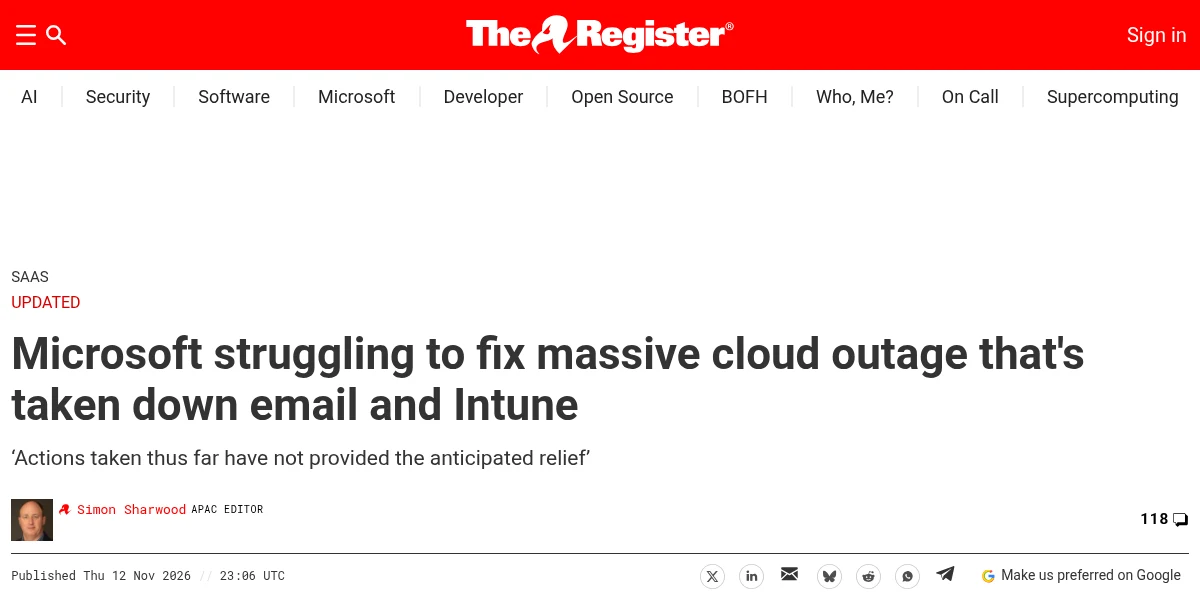
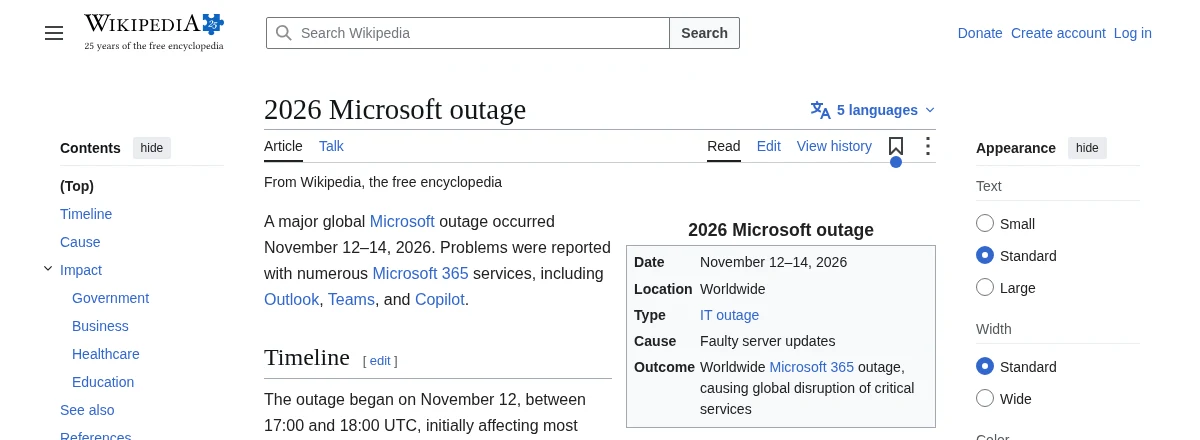
Affected, according to BleepingComputer and The Register: Exchange Online, Teams (mostly calendars, invites and scheduling; chat and joining meetings were reported as working), SharePoint Online, Microsoft 365 Copilot, Defender XDR and Defender for Office 365, Intune and the Microsoft 365 Apps admin center. Reports came from more than 70 countries. Among those hit are the NHS in Britain, healthcare in Toronto and education in Britain. Microsoft 365 has about 430 million users; how many were affected, nobody has said. I found no Greek coverage of the outage.
It wasn't the first time this year either. In January 2026 there was another big outage (MO1221364), and on 9 November a smaller incident in Outlook on the web in Europe, the Middle East and Africa.
What Microsoft said, and how the explanation changed
At first the picture was servers failing their automated health checks and dropping out, with "a core process on the affected servers" not coping. Microsoft said it hadn't found any change that caused it, and that the load was not down to more traffic: "the elevated load isn't driven by an increase in traffic, but by a number of servers being unexpectedly unavailable". In plain words: fewer servers carrying the same work.
On Friday it said there was no indication of malicious activity. Charles Lamanna, executive vice president at Microsoft, told BleepingComputer that Microsoft "regret the impact these outages had on those who depend on us".
Then the explanation changed. According to WindowsForum and a snippet from BetaNews, Microsoft put it down to a network capacity upgrade that surfaced when a later network change was made, and described it as a "technical issue not related to cyber or AI / agents". Wikipedia writes that settings applied after an upgrade overloaded the process that sets up secure connections, and that the network configuration change was rolled back. So from "we found no change" we got to "a change in the network". That's not bad in itself; it's how you find causes. But until the official review is out, this is the explanation as others relay it, not in Microsoft's own words.
And Defender?
This is the part that's on my mind the most, and it deserves its own section. According to ThreatAft, incident MO1550821 also named Microsoft Defender XDR among the potentially impacted services, as a degradation, not a full outage. And the question going around, which I'm asking too, is simple: when Defender can't ask the cloud whether a file is dangerous, what does it do? Did things get through on some machines that it would normally have stopped?
What Microsoft itself says about how it works:
- With Block at First Sight, when Defender finds a suspicious file, it keeps it blocked while it waits for an answer from the cloud: "By default, Block at first sight blocks the file for 10 seconds while waiting for a cloud determination", extendable to 60 seconds (Microsoft Learn).
- What happens if the answer never comes, the page doesn't say.
- If you turn cloud protection off, local protection remains: "Turning off cloud-delivered protection limits analysis to only what the client can provide through local machine-learning models, and similar functions" (Microsoft Learn). The page is about you turning it off, not an outage. My own conclusion is that in an outage too the machine isn't left unprotected, but judges only with what it has locally.
What we know about those days:
- No source I found says that cloud protection or Block at First Sight stopped on endpoints, or that any exploit or malware got through because of the outage. We don't even know whether the part of Defender that judges files runs on the same infrastructure as what went down.
- What analysts point out is something else, and more mundane. ThreatAft writes that when Defender XDR is degraded, alert visibility drops and automated remediation stops or becomes unreliable, and puts it this way: "The outage is not the attack. It is the window." Cyber Press notes that the portal being down doesn't by itself mean sensor telemetry or automated containment stopped, but advises teams to check that automatic device isolation actually fired.
So my own guess, that some machines were more exposed because Defender couldn't verify a file online, is a question, not a fact. It's a fair question, because a system that relies on the cloud for the hard calls is weaker when the cloud doesn't answer. But until Microsoft's review is out, or someone shows a real incident, I can't say it happened. If you manage Defender, though, those days are a good reason to look again at the alerts and the actions that should have happened.
On television: Dimitris Vagiakakos
My friend Dimitris Vagiakakos, a cybersecurity consultant (tuxhouse.eu), went live on Naftemporiki, a Greek financial news channel, to answer questions about the outage, and what he said fits very closely with what I lived through on the IT side.
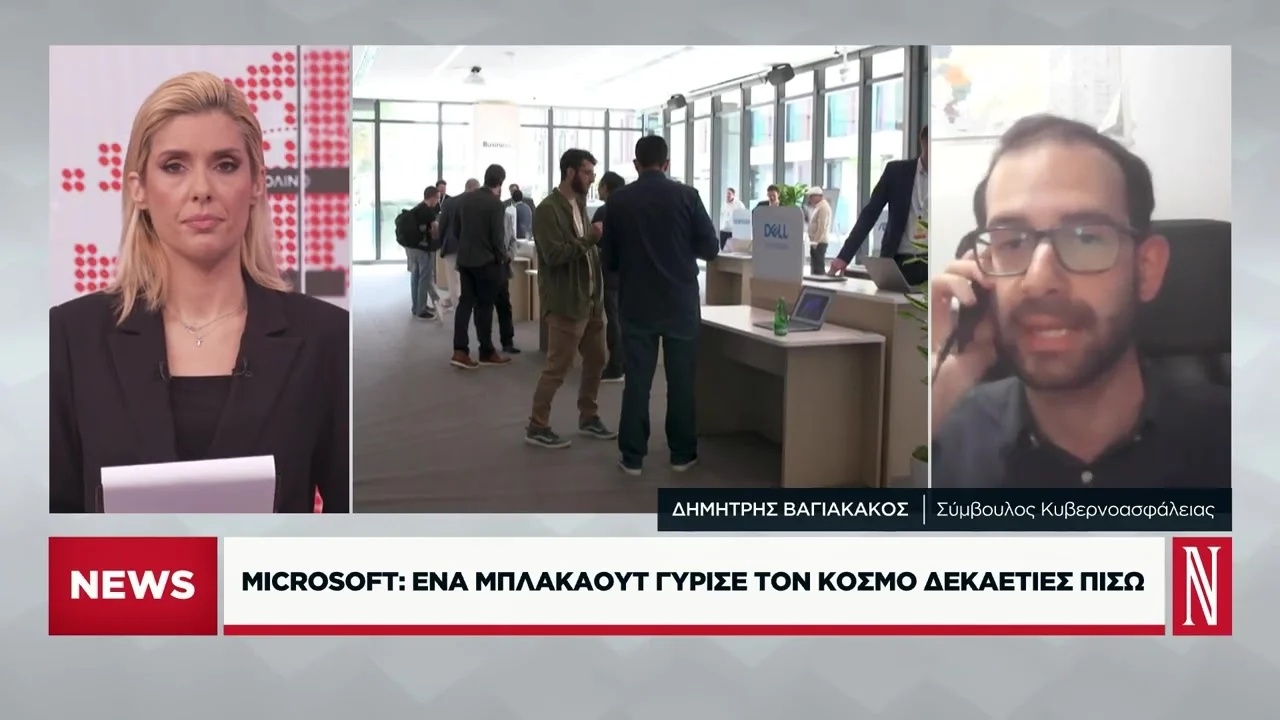
The main points he made:
- The cost. Almost a day without email paralysed many companies' work, and by his estimate the lost value runs to billions of euros. That's an expert's estimate, not a measured figure. I found no calculation with a method behind it, and a CNN figure going around I couldn't read, so I'm leaving it out.
- One provider for everything. The outage showed how dangerously companies rely on a single provider, with no second or alternative one.
- Not "if" but "when". Outages will happen again. The question is what you do when they do, with communication channels across different providers, even self-hosted or local ones.
- Exercises. Medium and large companies should regularly run tabletop exercises, where leadership plays out a scenario of the infrastructure going down.
- Shadow IT. When the official tool doesn't work, people send work files from their personal email and from apps nobody approved. That turns the outage into a risk of leaking company and customer data.
- Whether the outage had anything to do with the grounding of flights in the US, he says it's too early to tell.
The rumours: what holds and what doesn't
| Rumour | What we know |
|---|---|
| It was a cyberattack | No. Microsoft said there's no indication of malicious activity. |
| AI or an AI agent caused it | No. "not related to cyber or AI / agents", as the press reported it. |
| So many people logged in at once that it fell over | No. "isn't driven by an increase in traffic". |
| A network or configuration change | That's what the press says Microsoft said. We don't have its own wording or its review yet. |
| Defender let exploits through because it couldn't check files online | Open question, no evidence. Defender XDR is reported among the potentially impacted services, but no source reports anything getting through. See the Defender section. |
| November's Patch Tuesday is to blame | No evidence. The outage came two days after Patch Tuesday, but no source links them. |
| It cost billions | Plausible, but not measured. Dimitris Vagiakakos estimates it at billions of euros in lost value. I found no calculation with a method behind it. |
| It's linked to the grounding of flights in the US | We don't know. As Vagiakakos said, it's too early to tell. |
M364
The internet did what it does. A few of the posts on Mastodon, with each creator's name and link:


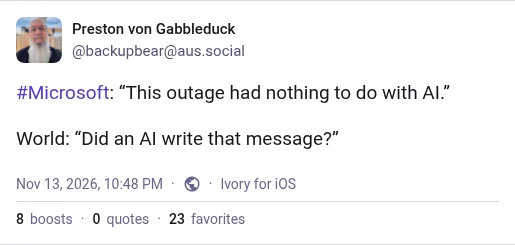
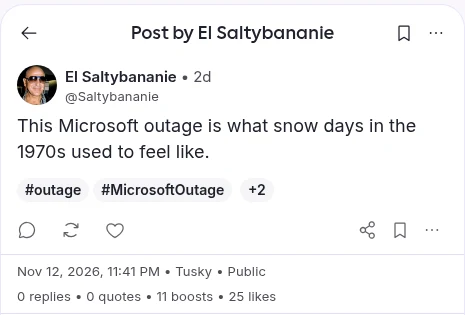
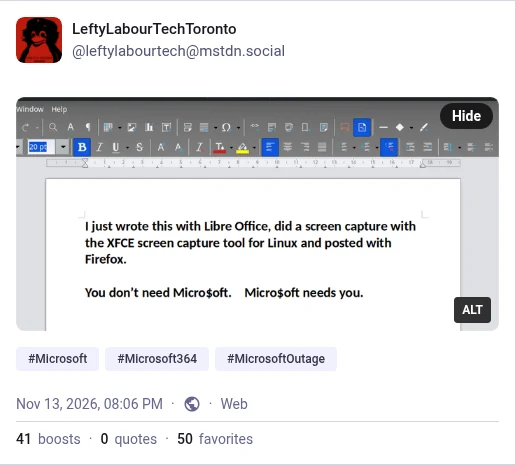
The images are screenshots of public posts and belong to their creators.
What I'm keeping for next time
These are the things I saw in practice, along with my own view on mail:
- The second road helped for one day. On Thursday, when Graph was throwing errors, connecting to Exchange directly was the fix. On Friday that went down too. Two roads to the same platform cover you halfway.
- The meeting link saved the meeting. I didn't wait for a calendar invite; I gave it out by hand in a chat outside Microsoft, and the meeting went ahead, with recording and transcription.
- A chat outside Microsoft 365 is worth having. That's where I shared the link. If all your communication goes through Teams and Exchange, on the day they go down you have no way to tell people.
 Keep a piece in your own hands. Mail was exactly Dimitris's example of relying on one provider. If you can, keep your mail, or at least a second channel, on your own server. The hard part of self-hosting is sending: your IP's reputation and keeping your mail out of spam folders. That's where a relay comes in. I recommend Forward Email, for the quality of its service and how well its mail gets delivered. SMTP sending is on its paid plans, from $3 a month, and it says it is open source. If you don't want your own server at all, it also has its own IMAP mailboxes. Its servers are mostly in the US, in Denver, with no EU-only option, which is worth knowing.
- Self-hosting moves the risk, it doesn't remove it. You become the one who wakes up at three in the morning. The relay is also a provider that can go down, and you still depend on DNS, your registrar and your internet provider. Backups, updates and spam filtering are yours. For most companies, the sensible move isn't to leave Microsoft 365 but to also have a second road that doesn't go through it.
- That day, Sent wasn't proof. My email had been delivered and just didn't show. Before you send again, check delivery, once the admin center lets you.
What I can't say yet
I couldn't read Microsoft's status pages directly (I tried 🤪), so its words here are as the press relayed them. The official post-incident review isn't out; according to some sites Microsoft said it would publish a preliminary one within two business days, but I haven't confirmed that. The sources I read don't mention a problem with Graph or with sign-in (Entra ID), so whether my Thursday errors and Friday's sign-in trouble were part of the same problem, I don't know. I'm writing what I saw, not its cause. When the review is out, I'll update this post.
In the end, the funniest part for me was a white page that, after four minutes, decided to show me only its menu. And the most serious part: to check whether the platform works, you need the platform itself.
Written on 15 November 2026.
Sources
- BleepingComputer: Massive Microsoft 365 outage disrupts Outlook, Teams, Copilot worldwide
- The Register: Microsoft struggling to fix massive cloud outage that's taken down email and Intune
- Wikipedia: 2026 Microsoft outage
- WindowsForum: on MO1550821 and the network change
- BetaNews (only a snippet read)
- Naftemporiki: "D. Vagiakakos: How a blackout set the world back decades", YouTube, in Greek
- ThreatAft: Microsoft 365 Outage: Defender XDR Down, Priya Jacob, 13 November
- Cyber Press: Microsoft 365 Outage Disrupts Outlook, Teams, Copilot and Defender XDR Worldwide, 13 November
- Microsoft Learn: Configure the cloud block timeout period
- Microsoft Learn: Cloud protection and sample submission